Talks
All talks
2026 4 talks
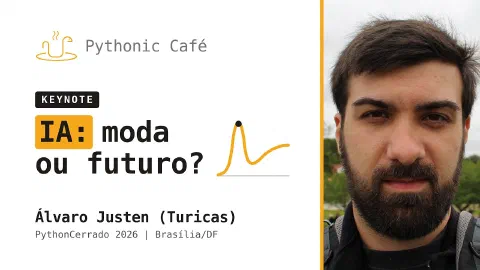
Keynote on keeping up with technology and its fads. Starting from my own path, from my first computer to ChatGPT, I revisit hypes such as cloud computing, NoSQL, big data and microservices to discuss the problems of always following the latest trend and what to expect from a future with artificial intelligence.
Why speech recognition models such as Whisper still make many more mistakes in Portuguese than in English: there is not enough good, openly licensed data. I present Mozilla Common Voice, where I am the Community Language Expert for Portuguese, and how anyone can contribute their own voice.
Tutorial on building command-line programs that are a pleasure to use. It starts from the user's point of view (with exercises), goes through what makes a CLI lovable or hateful and ends with the
argparsemodule and a summary of good practices. Requires knowing how to program in Python and how to use the terminal.How electoral data from TSE (Brazil's electoral court) is used in investigations, such as Abraji's CruzaGrafos, and what to do when transparency gets worse: columns that get renamed, files that disappear and candidates' CPFs (taxpayer IDs) that stopped being published in 2024. I show how to cross data from previous elections and scrape what is missing with Python and Scrapy.
2025 1 talk
Presentation of
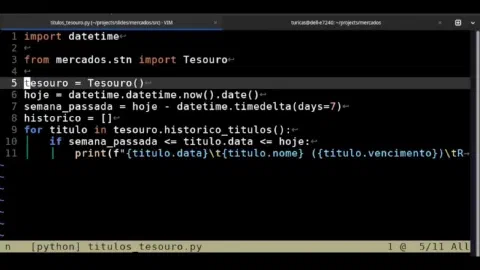
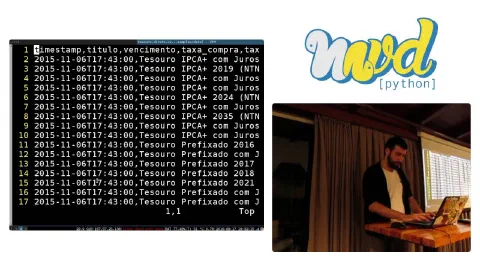
mercados, a free software Python library and command-line tool that downloads, extracts and cleans Brazilian financial market data straight from official sources. A person's financial journey (inflation, savings accounts, CDI, Tesouro Direto, real estate funds) guides the talk, which ends with how to contribute to the project.
2024 5 talks
With Ana Paula Sales. We present YouTool, a Python library and command-line tool for collecting YouTube data, and journalistic investigations that used it, such as monitoring deleted videos and anti-disinformation projects that led to stories in Brazilian and international outlets.
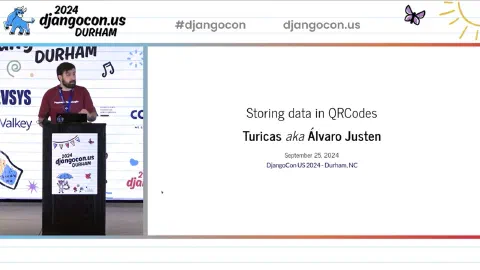
Lightning talk showing that QR codes, usually used for short URLs and payments, can store up to about 3 kB of data, with Python examples using the
qrcodelibrary, including a contact card (vCard) generated from the command line.Techniques to get the most out of PostgreSQL in Django applications, with examples from Brasil.IO and the Brazilian federal company registry: importing and exporting large amounts of data, modeling, metrics and full-text search.
Workshop, in a Colab notebook, on the techniques and tools of the three investigations supported by ICFJ's Disarming Disinformation, with Instituto Serrapilheira, which resulted in nine stories: collecting YouTube videos and transcripts with
youtool, transcribing audio with Whisper, summarizing transcripts with a large language model and full-text search in PostgreSQL. The examples use Abraji's channel, so as not to spread the disinformation videos.What open data is, what it is for and why so much of it is still hard to use, with examples of news stories built on it, tools for working with data and Brasil.IO, which gathers public datasets and makes them available in an accessible format.
2023 3 talks
Presentation of CruzaGrafos, an Abraji tool born from a 2019 idea and prototype, supported by the Google News Initiative, which uses Brasil.IO data to browse the relationships between people, companies and candidates, search for paths between them and export the data. It also shows the new features and datasets.
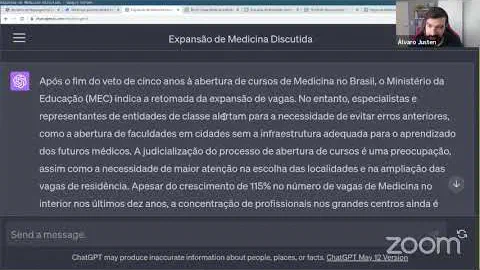
Introduction to machine learning, natural language processing and large language models such as ChatGPT, with applications in journalism and the problems of using them.
What large language models such as ChatGPT are, applications in law, such as extracting entities from documents, and the possible problems of using them, including for data protection.
2022 1 talk
Common problems when crossing open datasets (which also happen with private data) and methods to reconcile them in PostgreSQL with URLid, with examples from Brasil.IO, such as crossing companies barred from public contracts with campaign donors.
2021 4 talks
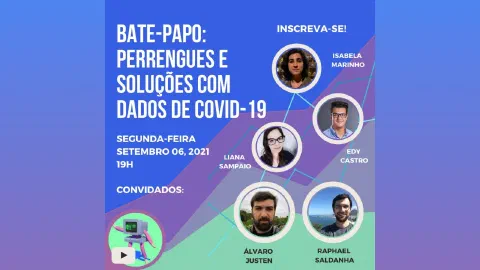
How Brasil.IO, with dozens of volunteers, collected and organized the bulletins of the state health departments to build an open dataset of COVID-19 cases and deaths by municipality, in the face of federal data without history, bulletins published as PDFs and images and methodologies changed without notice. It also covers disinformation and how to collaborate.
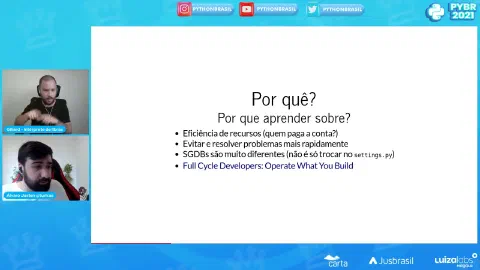
Python and PostgreSQL used together.
Participation in a MundoGEO Connect panel on how geographic data portals can help fight pandemics, talking about Brasil.IO's COVID-19 data.
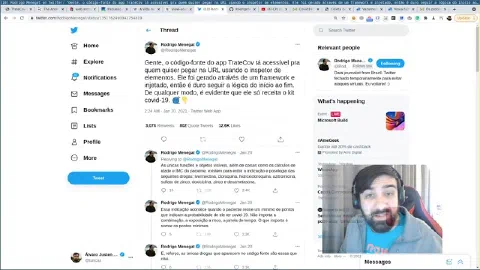
Technical explanation of the TrateCov case, a Brazilian Ministry of Health website that, according to the former minister at the Senate's COVID inquiry, was "hacked": how websites work (backend and frontend), why anyone had access to the code that runs in the browser and what should really be investigated, such as the lack of transparency and the leak of personal data.

2020 5 talks
Keynote on collaboration in free software and communities: starting from the phrase attributed to Isaac Newton, I show how projects such as
rowsand Brasil.IO depend on the work of many people and how we are more interdependent than we think, inside and outside technology.Interview in Spanish for PyCon Latam.
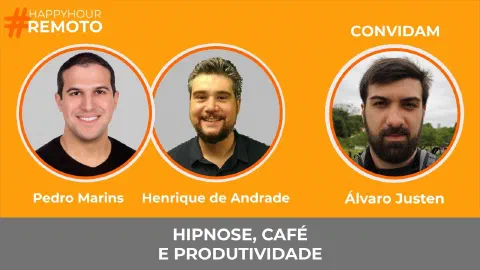
Conversation on Happy Hour Remoto #14 about hypnosis, coffee and productivity.
Conversations about working while traveling as a digital nomad, and about remote work.
Podcast Rio Bravo episode in which I talk about Brasil.IO.

2019 13 talks
Python for journalists.
What free software is and why it is not the same as freeware or open source software, what copyleft is and how these ideas relate to other collaborative movements.
Talk at PythonBrasil[15] about the conference's talk selection process and about what I had been working on: the post-truth keynote, data science in the terminal, the PGConf talk and
crau, a tool for archiving web pages.What open data is, what Brazil's Access to Information Law says and how public data enables citizen oversight, with Python tools for working with data and a presentation of Brasil.IO, which frees public datasets.
Why transparency depends on good-quality data and how Brazilian public data falls short of it, with stories of badly published open data and what we do at Brasil.IO to solve part of these problems.
Keynote on the post-truth era: examples of distorted reality, from the anti-vaccine movement to deep fakes and algorithmic bias, and thoughts on what we can do with data journalism, open data and Python, with live examples using Brasil.IO.
Free workshop on roasting coffee at home.
Open data, its problems and tools for working with it, with live coding, and how Brasil.IO uses PostgreSQL, plus plans for improvements such as using graphs.
How to analyze data using only the command line: navigating and handling files, filtering and combining commands to deal with files too big for spreadsheets, with examples of Brazilian public data. Some editions were hands-on tutorials.
What big data is (and is not): not being able to open a file in Excel does not mean you have big data, and systems such as PostgreSQL handle gigabytes of data with ease, with open data examples.
Behind the scenes of data journalism.
Journalistic work and applications built on public data, such as those by Gênero e Número and Operação Serenata de Amor, and the relationship between transparency, citizen oversight, copyright and open data.
Examples of news stories and applications built on open data, such as Operação Serenata de Amor and its robot Rosie, the idea of citizen oversight and Brasil.IO, which frees public data so more people can use it.
2018 10 talks
Tutorial on regular expressions for data cleaning: what they are, where to use them (and where not to) and how to represent patterns, testing them on regexr.com.
Open data, transparency and Brazil's Access to Information Law in the practice of data journalism, with examples of stories, the data funnel and live coding to solve common problems, such as converting tables from PDF to CSV.
Guest appearance on PodProgramar #42 about hacking public data.
Workshop for journalists on investigating public databases with SQL.
Guest appearance on episode 10 of the Pizza de Dados podcast about open data, open source and other topics.
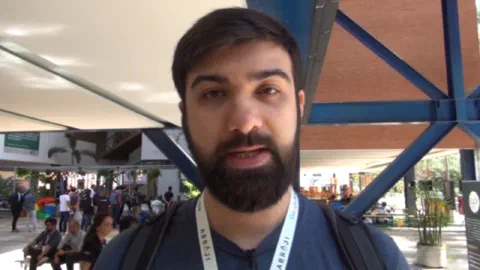
Interview with Abraji about Brasil.IO and public data.
The story of Brasil.IO: why software alone is not enough to free data, usability as part of accessibility and the datasets available on the platform at the time, such as elections, company partners, judges' salaries and congressional expense allowances.
Lightning talk about automation and coffee: from the fruit to the roasted bean, and how Python can collect sensor data, log everything and control the gas and the doors of a 12 kg roasting machine to reproduce any roast profile.
Guest appearance on Live de Python #45 about the
rowslibrary.What open data is and Brazil's Access to Information Law, with examples from Gênero e Número and techniques for collecting data with Python.
2017 7 talks
Introduction to programming for journalism using Python, in three parts: logic and basic concepts of the language, reading CSV datasets and computing statistics, and collecting data from the web.
How Python helped Gênero e Número investigate gender issues in Brazil with open data and data journalism techniques, with examples of stories, the open methodology and code snippets.
Introduction to Python for people who do not program yet or do not know the language: its features, basic concepts with live coding, the ecosystem and the community.
Introduction to programming logic with Python for people who have never programmed: what programming is for, when spreadsheets are not enough and the basic concepts of the language.
Keynote in which I tell the story of starting the PythonQuito community in Ecuador and explain what a software license is, what Brazilian copyright law says and what the freedoms of free software are.
Public data that is open but not accessible, and how to automate with free software the boring steps of getting, checking, cleaning and converting it, with the
rowslibrary and its command-line tool.Two-part conversation on BalCast #27 about financial planning.
2016 8 talks
Presentation of the
rowslibrary at Grupy-PR.Lightning talk on why free software and open source are not the same thing.
How the
rowslibrary evolved between UaiPython 2015 and PythonSudeste 2016, with examples of reading and converting tabular data with and without it.What tabular data is, the Python libraries for handling it and
rows, which reads and converts many formats, such as CSV, spreadsheets and HTML, with the same interface, including from the command line.Introduction to Arduino, a free software and hardware project that makes it easier to build projects with electronics and programming: what a microcontroller is, what it is for and how to get started.
Interview for PythonRio's interview series.
Introduction to Arduino and robotics with free software and hardware: the history of the project, the board, the IDE and example projects, hands-on.
Science outreach talk about hypnosis: what it is (and what it is not), with optional hands-on exercises for the audience.
2015 2 talks
The problems of accessing open data in Brazil and how to collect it with Python, with live coding using the
rowslibrary and the first steps of Brasil.IO.Workshop on how to contribute to free software in Python through GitHub, using the Aleph project as an example: documentation and code style, Git and git flow, eXtreme Programming and TDD.
2014 1 talk
The problems of accessing environmental data (water, air), how to integrate systems through APIs, reverse engineering and crawling, and the licenses that define what can be done with the data.
2013 6 talks
Introduction to the Python language: what it is, where it is used, the interpreter, basic syntax, flow control, data structures, functions, classes, modules and the standard library.
Introduction to Python and Arduino and how to integrate them.
Free hands-on Arduino workshop, building circuits and programming them.
Presentation of PyPLN, a natural language processing platform in Python developed at FGV: NLP problems, its architecture based on
pypelininand a demo.Keynote about persistent and scalable dictionaries in Python.
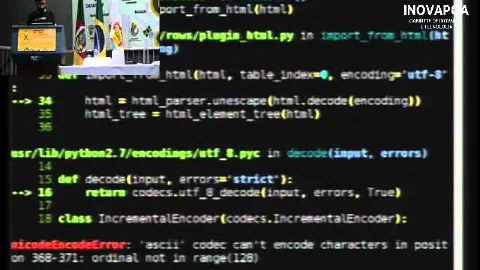
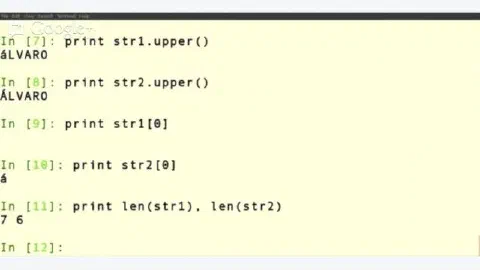
Character encoding and Unicode in Python: why accented characters cause so many problems and how to handle them correctly.
2012 3 talks
Home automation with Android and Arduino.
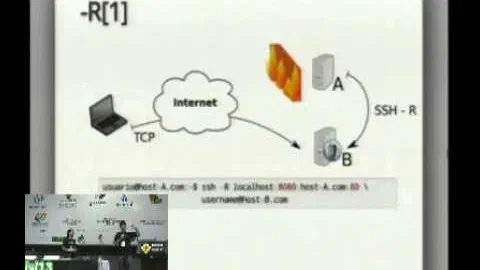
Little-known SSH tips and tricks.
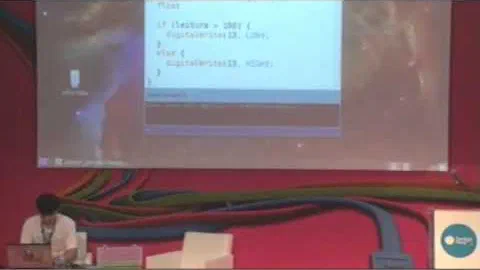
Interactive design and electronics, at Campus Party Brasil 4.
2011 10 talks
What version control systems are and why to use them (history, rollbacks, collaboration), with examples of systems and a focus on Git.
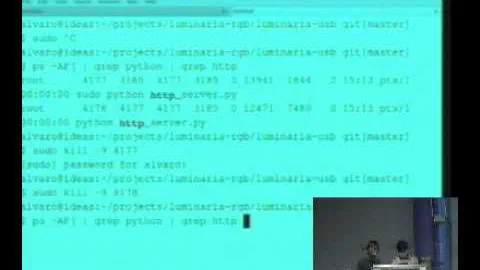
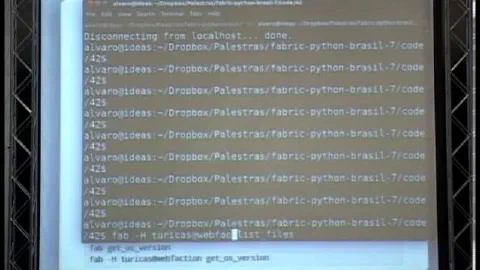
How to manage servers programmatically with Fabric, a Python library for automating tasks over SSH.
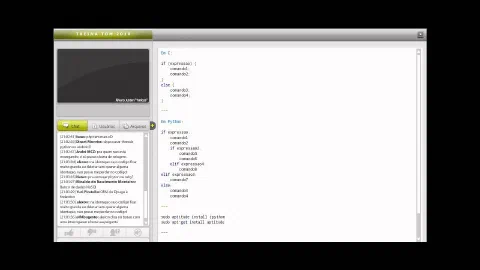
With Tatiana Al-Chueyr. How to control everything from LEDs to home appliances with Python, Android and Arduino.
Talk in Spanish at PyConAr 2011 about integrating Python with Arduino for robotics.
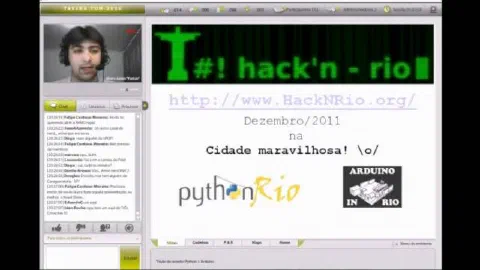
Online talk at Lab de Garagem about integrating Python and Arduino.
Castálio Podcast episode, with Og Maciel, about Arduino, my courses and my path.
Online talk at Lab de Garagem: an introduction to the Python language, with examples, and a quick look at integrating it with Arduino.
Online talk at Lab de Garagem on advanced Arduino topics.
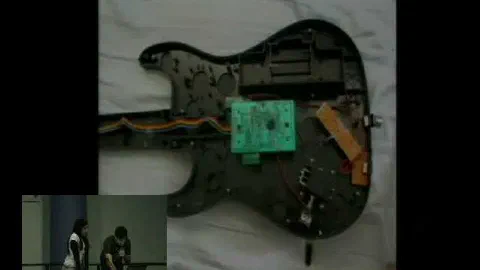
A guitar built with Arduino to play Frets on Fire, a project I developed with Tatiana Al-Chueyr: a 100% free Guitar Hero.
Community meeting about free embedded computing platforms: Arduino, eLua, TinyOS and Mindstorms.

2010 7 talks
Online talk about Arduino in Lab de Garagem's talk series.
How to build robots with Arduino, using free software and hardware.
Lightning talk about Intelie Event Manager, a monitoring tool by Intelie, where I worked.
With Douglas Andrade. Presentation of web2py, a Python web framework.
The Coding Dojo and development practices such as pair programming and test-driven development.
The MVC pattern, some web frameworks written in Python and web2py, with code samples.
Lightning talk about free software communities and the small acts that make them grow, such as the GNU Manifesto.
2008 3 talks
Free software on desktops, focusing on the Debian GNU/Linux distribution and its derivatives.
History of the free software movement, concepts, GNU/Linux and distributions, and free software applications in telecommunications: network servers, VoIP, wireless mesh networks and thin clients.
GNU/Linux short course.
2007 1 talk
Mesh networks (wireless mesh networks) and UFF's experience with them.
2005 1 talk
My first talk: what free software is, the GNU Project and Linux.